
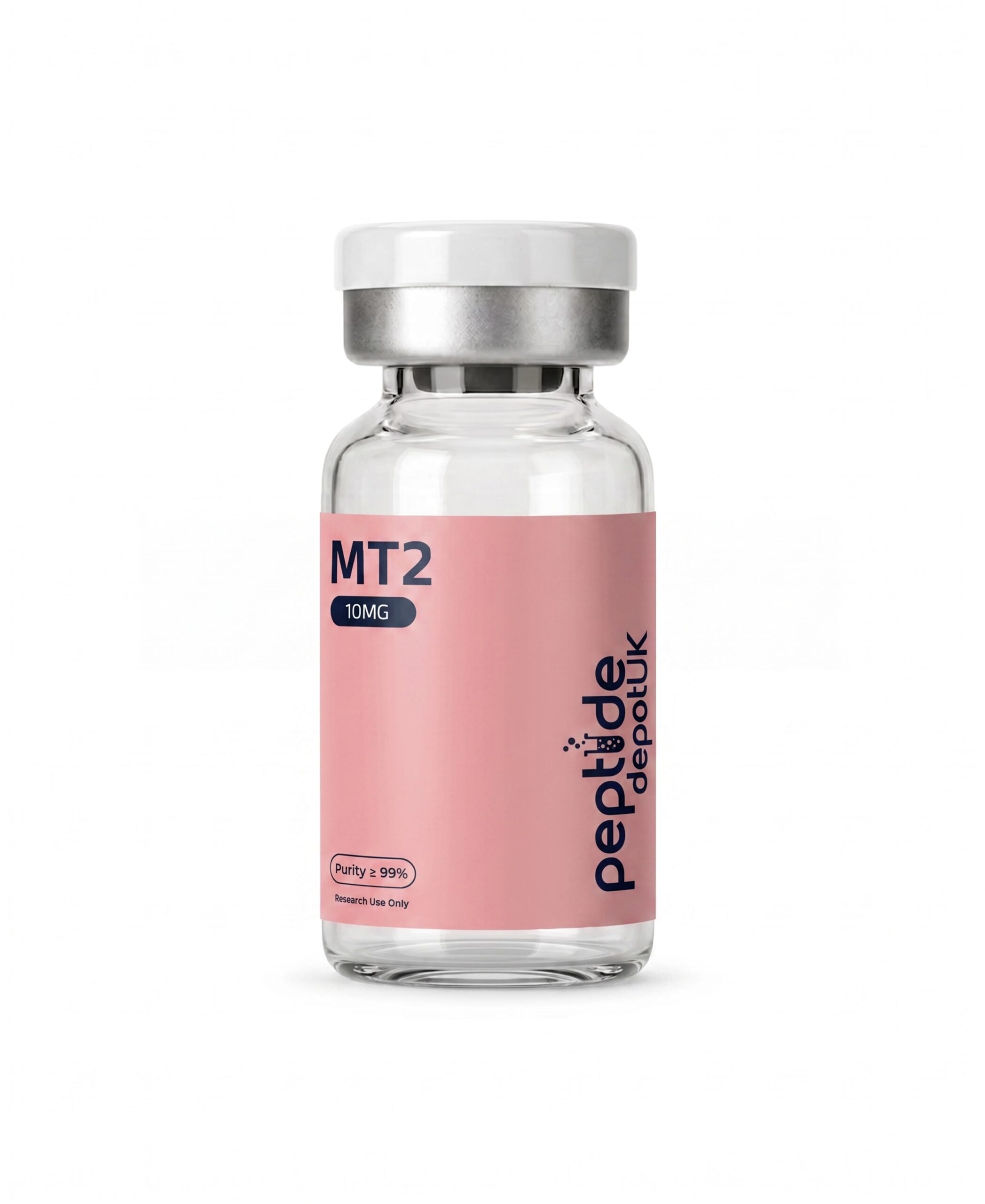
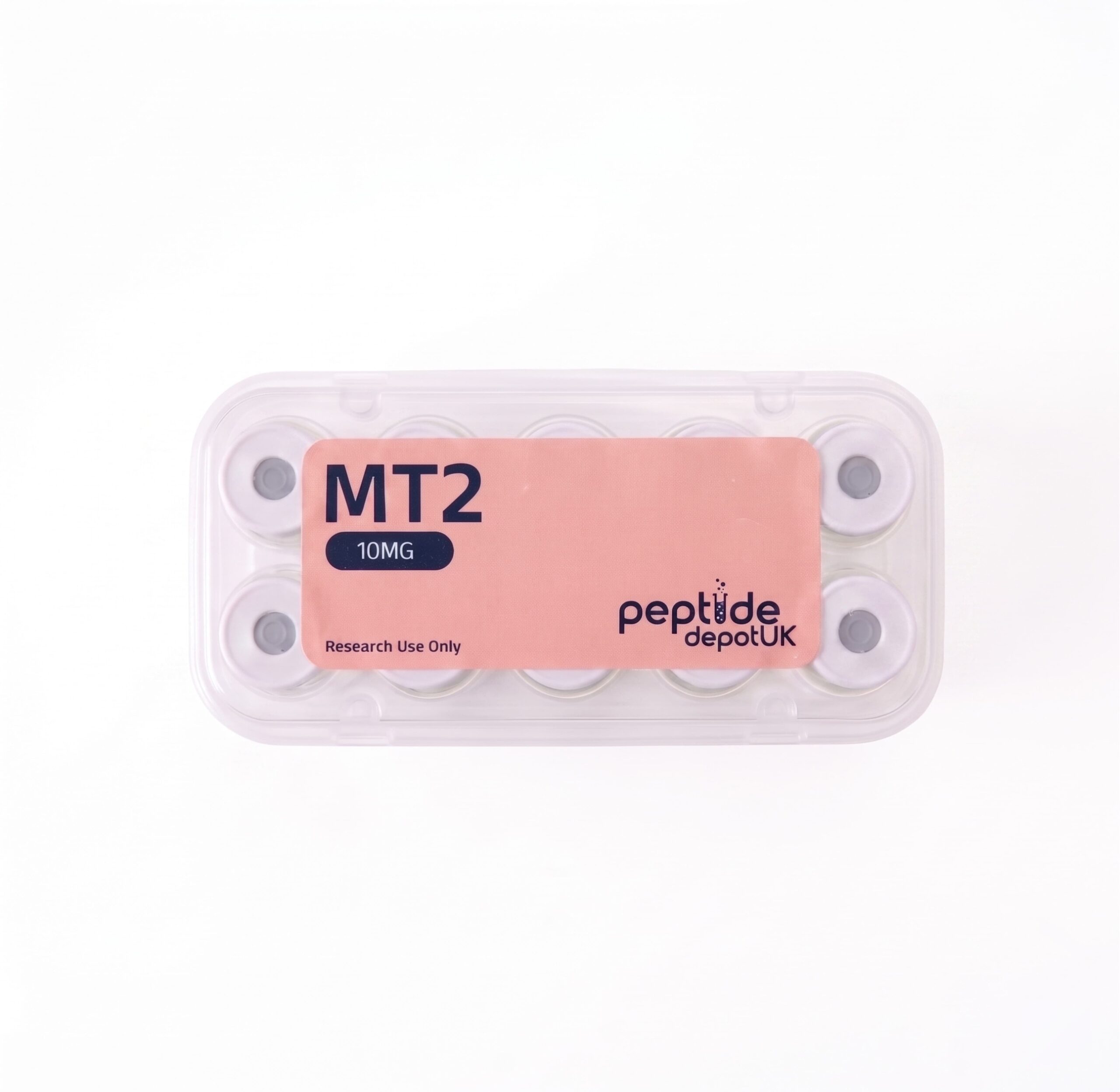






Melanotan 2 (10 Vials)

Trusted & appreciated by 5,000+ researchers

From £75.00

Buy Now
Stock up & save
£75.00
1 Box
(10 vials)
5% Off
£71.00
2 Boxes
(20 vials)
8% Off
£69.00
3 Boxes
(30 vials)
12% Off
£66.00
5 Boxes
(50 vials)
For Laboratory Research Only: This listing is intended strictly for qualified researchers conducting laboratory work. Completing a purchase confirms you meet this criteria and will not use the product for personal or human consumption.
We accept
Visa
Mastercard
Google Pay
Bitcoin
Ethereum

Description

Melanotan 2

Melanotan 2 (MT-II) is a synthetic cyclic peptide and non-selective agonist across the melanocortin receptor family, designed as an analogue of alpha-melanocyte-stimulating hormone (α-MSH), a naturally occurring hormone involved in pigmentation, appetite regulation, and sexual function (Rösler & Giuliano, 2014).

Mechanism of Action

  • MT-II activates several melanocortin receptor subtypes (MC1R through MC5R), with research attention particularly focused on MC3R and MC4R, receptors expressed in brain regions tied to appetite control, energy balance, and arousal
  • By engaging these central nervous system receptors, MT-II has shown in preclinical models an ability to suppress food intake and reduce appetite-driven behaviour without triggering an aversive response (Rupprecht et al., 2022)
  • Activity at MC1R has also been documented, a receptor linked to pigment-producing skin cells (Kim et al., 2023)

Key Research Findings

  • An early double-blind, placebo-controlled crossover study found MT-II initiated erection in 17 of 20 male subjects with erectile dysfunction, with 68% of MT-II doses associated with increased sexual desire versus 19% for placebo (Wessells et al., 2000)
  • Rodent studies showed dose-dependent enhancement of peripheral nerve regeneration, along with partial protection against chemotherapy-induced nerve damage (Giuliano et al., 2003)
  • MT-II has served as a research tool for mapping the melanocortin system’s role across processes including thermogenesis, feeding behaviour, and neuroendocrine signalling (Rupprecht et al., 2022)

For research use only. Not intended for use in humans or animals.

References

Giuliano, F., Clément, P., Droupy, S., Alexandre, L., & Bernabé, J. (2003). https://pubmed.ncbi.nlm.nih.gov/12591111/
Kim, J., Cho, Y., Nam, G., & Choi, S. (2023). https://pmc.ncbi.nlm.nih.gov/articles/PMC10418475/
Rösler, M., & Giuliano, F. (2014). https://pubmed.ncbi.nlm.nih.gov/25096243/
Rupprecht, L. E., Doyle, M. R., Kohut, S. J., & Bergman, J. (2022). https://pubmed.ncbi.nlm.nih.gov/36155088/
Wessells, H., Levine, N., Hadley, M. E., Dorr, R., & Hruby, V. (2000). https://pubmed.ncbi.nlm.nih.gov/11035391/
Additional information

Size

10mg/vial

What is a peptide, exactly?

Peptides are short chains of amino acids, smaller than proteins, that function as signalling molecules within biological systems. They're involved in processes such as tissue repair, immune activity, and communication between cells.

What role do peptides play in research?

Peptides are studied for how selectively they bind to receptors and influence specific cellular pathways. That precision makes them a valuable tool in laboratory settings for investigating how biological systems function at a molecular level.

What are my payment options?

Card payment, UK bank transfer, and cryptocurrency (Bitcoin and Ethereum) are all accepted.

How do I store this product correctly?

This product ships lyophilised (freeze-dried) to remain stable throughout transit and storage. Keep it cool, dry, and shielded from direct light before use, refrigerating if holding it longer term. Once reconstituted, refrigerate immediately and handle with standard sterile technique to preserve integrity.

What are your shipping timeframes?

Delivery is UK-only. Orders placed before 2pm on a business day go out same-day; anything later, or placed on a weekend, ships the next business day. Most orders arrive within 48 hours of dispatch, with tracking sent directly to you. Orders over £200 ship free automatically.

What's your policy on returns?

As a research product, this item isn't eligible for standard returns. If it arrives damaged or you received the wrong item, reach out within 48 hours and we'll get it resolved.

How is purity confirmed for this product?

Every batch is independently tested in a laboratory before listing, confirming it meets research-grade purity standards. A Certificate of Analysis is available for this product.

Melanotan 2

Melanotan 2 (MT-II) is a synthetic cyclic peptide and non-selective agonist across the melanocortin receptor family, designed as an analogue of alpha-melanocyte-stimulating hormone (α-MSH), a naturally occurring hormone involved in pigmentation, appetite regulation, and sexual function (Rösler & Giuliano, 2014).

Mechanism of Action

  • MT-II activates several melanocortin receptor subtypes (MC1R through MC5R), with research attention particularly focused on MC3R and MC4R, receptors expressed in brain regions tied to appetite control, energy balance, and arousal
  • By engaging these central nervous system receptors, MT-II has shown in preclinical models an ability to suppress food intake and reduce appetite-driven behaviour without triggering an aversive response (Rupprecht et al., 2022)
  • Activity at MC1R has also been documented, a receptor linked to pigment-producing skin cells (Kim et al., 2023)

Key Research Findings

  • An early double-blind, placebo-controlled crossover study found MT-II initiated erection in 17 of 20 male subjects with erectile dysfunction, with 68% of MT-II doses associated with increased sexual desire versus 19% for placebo (Wessells et al., 2000)
  • Rodent studies showed dose-dependent enhancement of peripheral nerve regeneration, along with partial protection against chemotherapy-induced nerve damage (Giuliano et al., 2003)
  • MT-II has served as a research tool for mapping the melanocortin system’s role across processes including thermogenesis, feeding behaviour, and neuroendocrine signalling (Rupprecht et al., 2022)

For research use only. Not intended for use in humans or animals.

References

Giuliano, F., Clément, P., Droupy, S., Alexandre, L., & Bernabé, J. (2003). https://pubmed.ncbi.nlm.nih.gov/12591111/
Kim, J., Cho, Y., Nam, G., & Choi, S. (2023). https://pmc.ncbi.nlm.nih.gov/articles/PMC10418475/
Rösler, M., & Giuliano, F. (2014). https://pubmed.ncbi.nlm.nih.gov/25096243/
Rupprecht, L. E., Doyle, M. R., Kohut, S. J., & Bergman, J. (2022). https://pubmed.ncbi.nlm.nih.gov/36155088/
Wessells, H., Levine, N., Hadley, M. E., Dorr, R., & Hruby, V. (2000). https://pubmed.ncbi.nlm.nih.gov/11035391/