
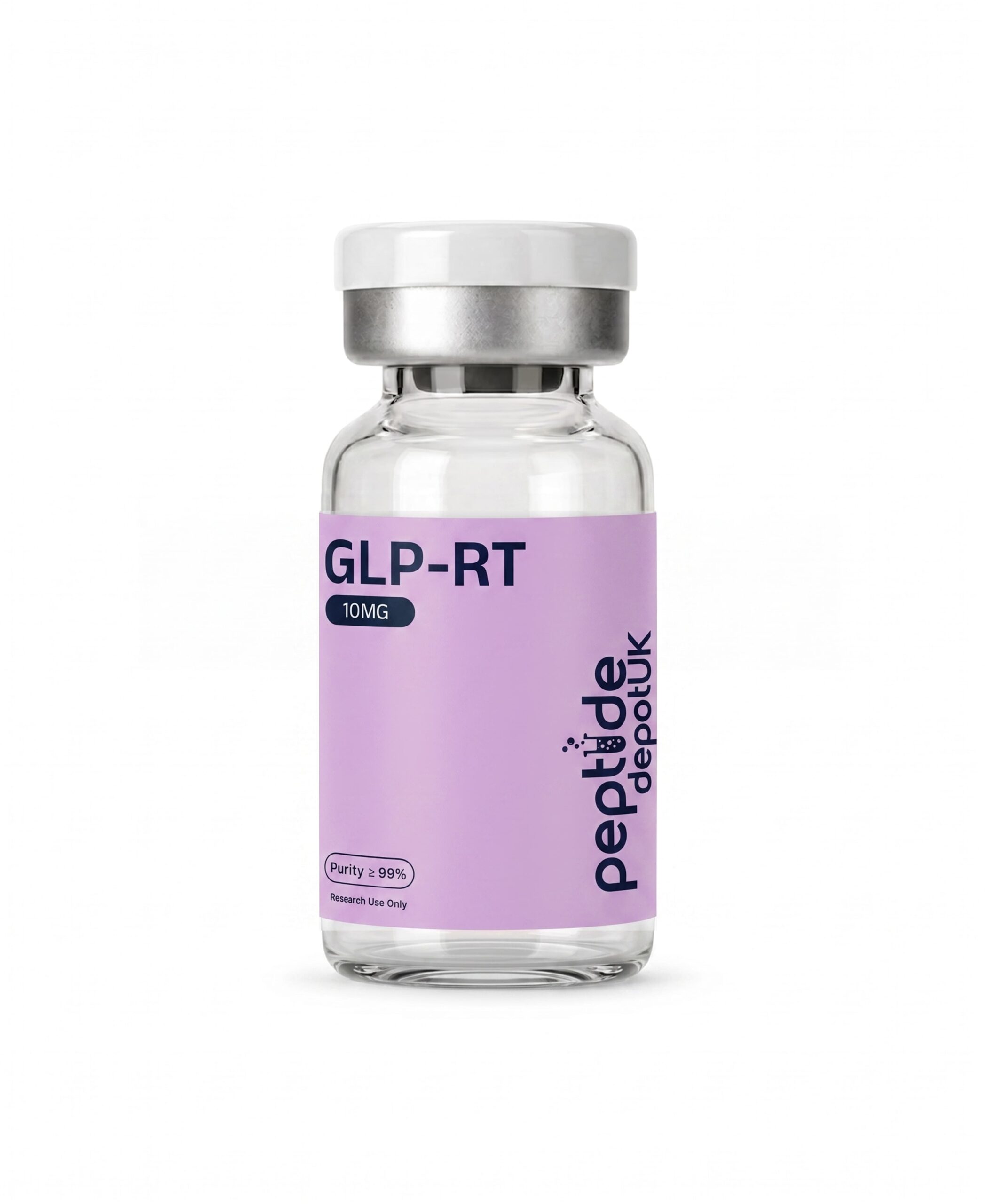
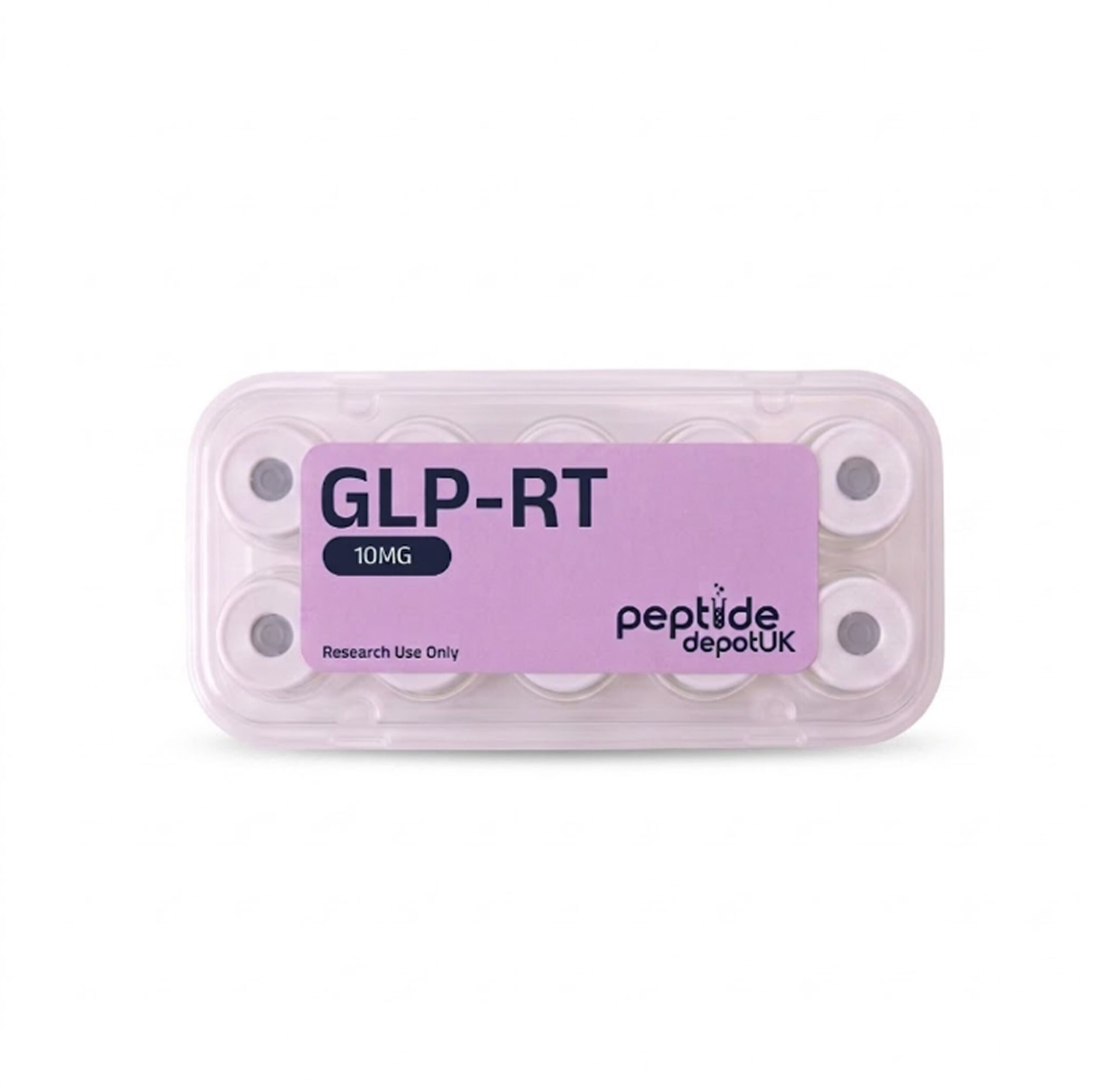






GLP-RT (10 Vials)

Trusted & appreciated by 5,000+ researchers

From £134.00

COA
Buy Now
Stock up & save
£134.00
1 Box
(10 vials)
8% Off
£123.00
2 Boxes
(20 vials)
15% Off
£114.00
3 Boxes
(30 vials)
22% Off
£105.00
5 Boxes
(50 vials)
For Laboratory Research Only: This listing is intended strictly for qualified researchers conducting laboratory work. Completing a purchase confirms you meet this criteria and will not use the product for personal or human consumption.
We accept
Visa
Mastercard
Google Pay
Bitcoin
Ethereum

Description

Three receptor pathways, one molecule. GLP-RT (LY3437943) was the first triple agonist of its kind to enter clinical trials, engaging GLP-1, GIP, and glucagon receptors in a single 39-amino acid peptide. Where tirzepatide combined two of these pathways, GLP-RT adds a third: glucagon receptor activation, which changes what the compound is capable of doing metabolically (Jastreboff et al., 2023).

Why the glucagon receptor matters

Most incretin-based compounds stop at GLP-1 and GIP, both of which influence insulin and appetite but leave energy expenditure largely untouched. Glucagon receptor activation is what closes that gap: it drives fat breakdown directly and increases how much energy the body burns. It also has a direct line to the liver specifically, an organ with dense glucagon receptor expression but essentially none for GLP-1 or GIP, positioning GLP-RT as a compound of interest for liver-focused metabolic research (Bhatt et al., 2024). A fatty diacid chain built into the molecule extends its half-life enough to support once-weekly dosing, with additional structural changes guarding against enzymatic breakdown (Nair et al., 2025).

What the trials showed

  • Obesity (phase 2): the 12 mg group lost an average of 24.2% of body weight across 48 weeks, and crucially, the weight loss curve hadn’t plateaued by trial’s end. That figure outpaced both GLP-SM and GLP-TZ at matched timepoints (Jastreboff et al., 2023)
  • Type 2 diabetes (phase 2): 82% of participants on the 12 mg dose brought HbA1c down to 6.5% or below within 36 weeks, with weight reductions running as high as 16.9% in the same group (Rosenstock et al., 2023)
  • Liver disease (phase 2a): liver fat dropped by up to 82% in subjects with metabolic liver disease, results strong enough that phase 3 trials are now running concurrently across obesity, type 2 diabetes, and liver disease (Harrison et al., 2024)

For research use only. Not intended for use in humans or animals.

References

Harrison, S. A., Taub, R., Neff, G. W., Lucas, K. J., Labriola, D., Moussa, S. E., Younossi, Z. M., & Loomba, R. (2024). https://www.nature.com/articles/s41591-024-03018-2
Jastreboff, A. M., Kaplan, L. M., Frías, J. P., Wu, Q., Du, Y., Gurbuz, S., & Wadden, T. A. (2023). https://www.nejm.org/doi/full/10.1056/NEJMoa2301972
Nair, A., Rodrigues, A., & Fonseca, V. (2025). https://pmc.ncbi.nlm.nih.gov/articles/PMC12190491/
Rosenstock, J., Frias, J., Jastreboff, A. M., Du, Y., Lou, J., & Gurbuz, S. (2023). https://pubmed.ncbi.nlm.nih.gov/37385280/
Additional information

Size

10mg/vial, 20mg/vial, 30mg/vial, 40mg/vial

What is a peptide, exactly?

Peptides are short chains of amino acids, smaller than proteins, that function as signalling molecules within biological systems. They're involved in processes such as tissue repair, immune activity, and communication between cells.

What role do peptides play in research?

Peptides are studied for how selectively they bind to receptors and influence specific cellular pathways. That precision makes them a valuable tool in laboratory settings for investigating how biological systems function at a molecular level.

What are my payment options?

Card payment, UK bank transfer, and cryptocurrency (Bitcoin and Ethereum) are all accepted.

How do I store this product correctly?

This product ships lyophilised (freeze-dried) to remain stable throughout transit and storage. Keep it cool, dry, and shielded from direct light before use, refrigerating if holding it longer term. Once reconstituted, refrigerate immediately and handle with standard sterile technique to preserve integrity.

What are your shipping timeframes?

Delivery is UK-only. Orders placed before 2pm on a business day go out same-day; anything later, or placed on a weekend, ships the next business day. Most orders arrive within 48 hours of dispatch, with tracking sent directly to you. Orders over £200 ship free automatically.

What's your policy on returns?

As a research product, this item isn't eligible for standard returns. If it arrives damaged or you received the wrong item, reach out within 48 hours and we'll get it resolved.

How is purity confirmed for this product?

Every batch is independently tested in a laboratory before listing, confirming it meets research-grade purity standards. A Certificate of Analysis is available for this product.

Three receptor pathways, one molecule. GLP-RT (LY3437943) was the first triple agonist of its kind to enter clinical trials, engaging GLP-1, GIP, and glucagon receptors in a single 39-amino acid peptide. Where tirzepatide combined two of these pathways, GLP-RT adds a third: glucagon receptor activation, which changes what the compound is capable of doing metabolically (Jastreboff et al., 2023).

Why the glucagon receptor matters

Most incretin-based compounds stop at GLP-1 and GIP, both of which influence insulin and appetite but leave energy expenditure largely untouched. Glucagon receptor activation is what closes that gap: it drives fat breakdown directly and increases how much energy the body burns. It also has a direct line to the liver specifically, an organ with dense glucagon receptor expression but essentially none for GLP-1 or GIP, positioning GLP-RT as a compound of interest for liver-focused metabolic research (Bhatt et al., 2024). A fatty diacid chain built into the molecule extends its half-life enough to support once-weekly dosing, with additional structural changes guarding against enzymatic breakdown (Nair et al., 2025).

What the trials showed

  • Obesity (phase 2): the 12 mg group lost an average of 24.2% of body weight across 48 weeks, and crucially, the weight loss curve hadn’t plateaued by trial’s end. That figure outpaced both GLP-SM and GLP-TZ at matched timepoints (Jastreboff et al., 2023)
  • Type 2 diabetes (phase 2): 82% of participants on the 12 mg dose brought HbA1c down to 6.5% or below within 36 weeks, with weight reductions running as high as 16.9% in the same group (Rosenstock et al., 2023)
  • Liver disease (phase 2a): liver fat dropped by up to 82% in subjects with metabolic liver disease, results strong enough that phase 3 trials are now running concurrently across obesity, type 2 diabetes, and liver disease (Harrison et al., 2024)

For research use only. Not intended for use in humans or animals.

References

Harrison, S. A., Taub, R., Neff, G. W., Lucas, K. J., Labriola, D., Moussa, S. E., Younossi, Z. M., & Loomba, R. (2024). https://www.nature.com/articles/s41591-024-03018-2
Jastreboff, A. M., Kaplan, L. M., Frías, J. P., Wu, Q., Du, Y., Gurbuz, S., & Wadden, T. A. (2023). https://www.nejm.org/doi/full/10.1056/NEJMoa2301972
Nair, A., Rodrigues, A., & Fonseca, V. (2025). https://pmc.ncbi.nlm.nih.gov/articles/PMC12190491/
Rosenstock, J., Frias, J., Jastreboff, A. M., Du, Y., Lou, J., & Gurbuz, S. (2023). https://pubmed.ncbi.nlm.nih.gov/37385280/